I currently work on Windows, where our team focuses on making your PC experience more powerful and delightful with AI, while also scaling new tooling across the studio.
I'm a self-taught designer with an engineering background, specializing in simple and effortless experiences for both the devices we use today and the ones we'll use in the future. Crafting high-quality products that people love to use is my passion, and I work tirelessly to achieve that goal.
Using the medium of motion and rapid prototyping I bring these experiences to life, visualizing the smallest interactions to entire user journeys. I strongly believe in open design, and encourage co-creation that can help deliver a better solution for users.
Accessibility and inclusion sit at the center of my process — technology should empower everyone and nobody should be left with a subpar experience.
I'm currently a Senior Designer at Microsoft, where I currently work on Windows AI.
Previously a Design Intern at Microsoft, where I was involved with products used by millions of people around the world. Check them out: Surface Duo, SwiftKey, Fluent Icons. Before that, I worked independently on critically acclaimed concepts both by myself and friends.
BSc Computer Science graduate — First Class Honours.
Awarded 2018-19 Microsoft MVP (Most Valuable Professional) for Windows Design.
Feature completeness and tighter integration with the Windows surfaces around it.
Not affiliated with Microsoft
Your Phone redesign isn't affiliated with Microsoft. Concepts and mockups shown do not represent any product plans past, present, or future.
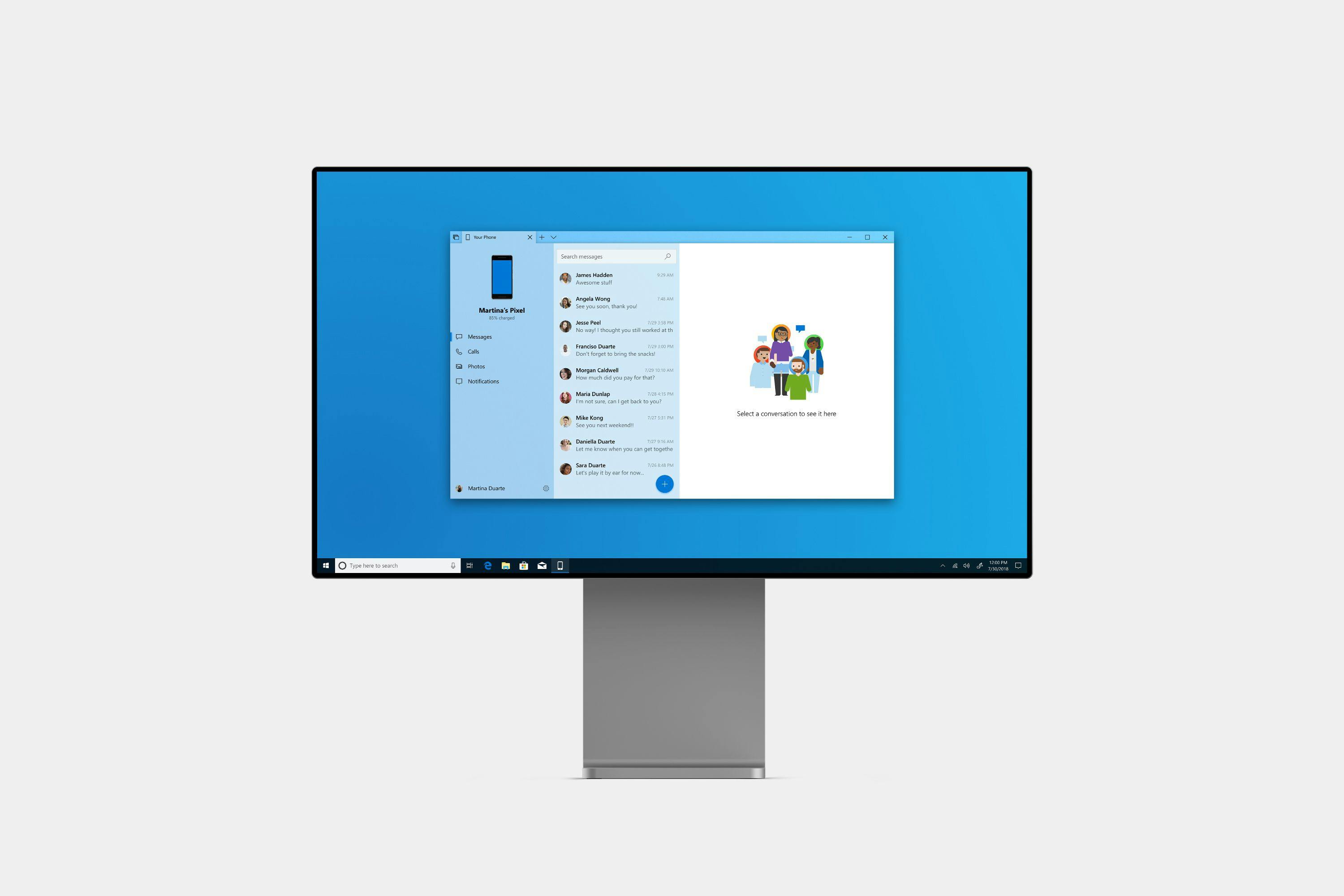
Your Phone ships with the Windows 10 October 2018 update: a new way to access phone messages and photos from the PC. Messages and photos is a strong floor and this concept explores the ceiling.
This concept proposes a version of Your Phone that goes further on feature completeness and pulls the app into the Windows surfaces it's already adjacent to such as MyPeople, Windows Ink, and Bing. These are what would make Your Phone feel like a truly integrated Windows experience rather than a phone mirror.
Messages
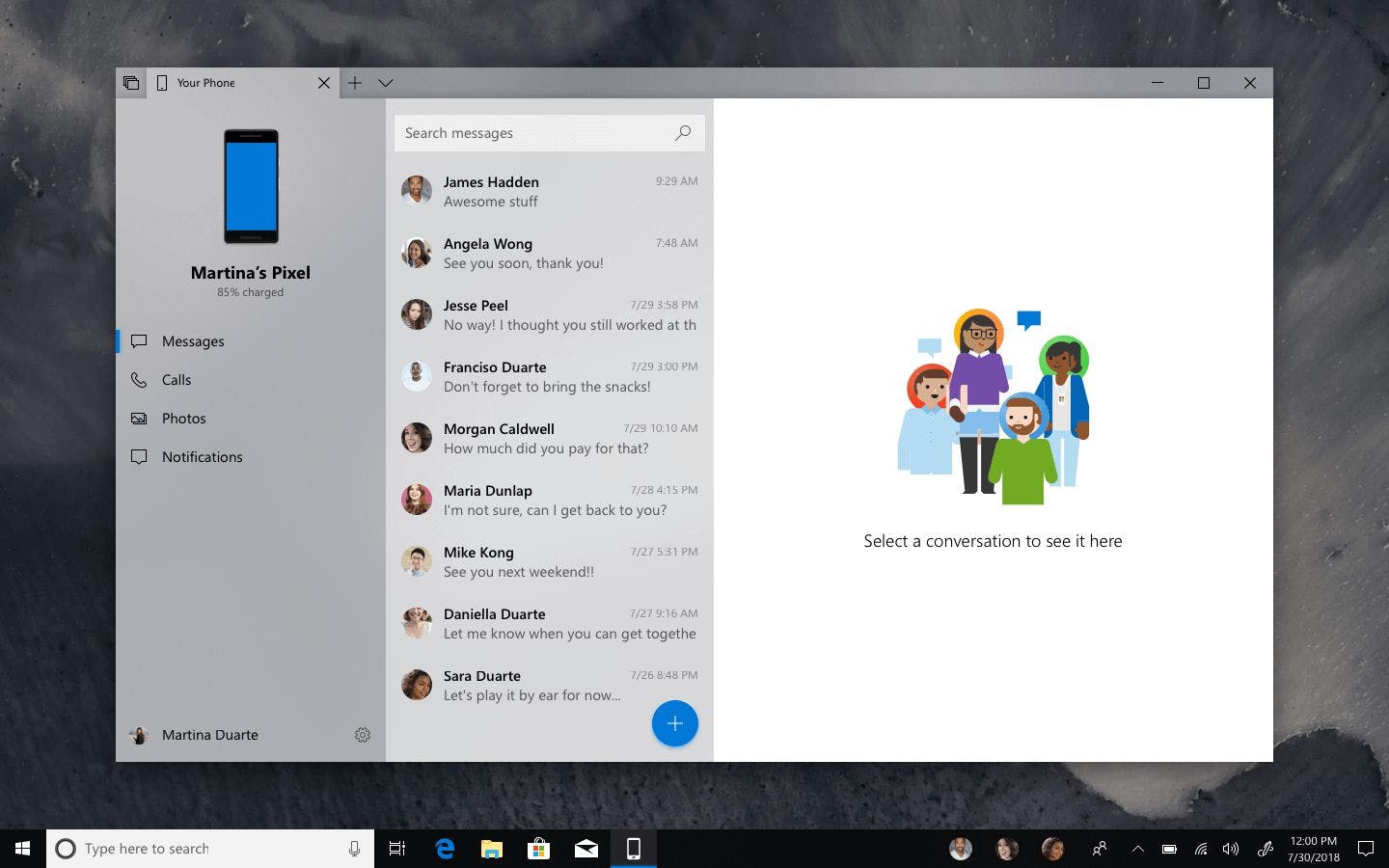
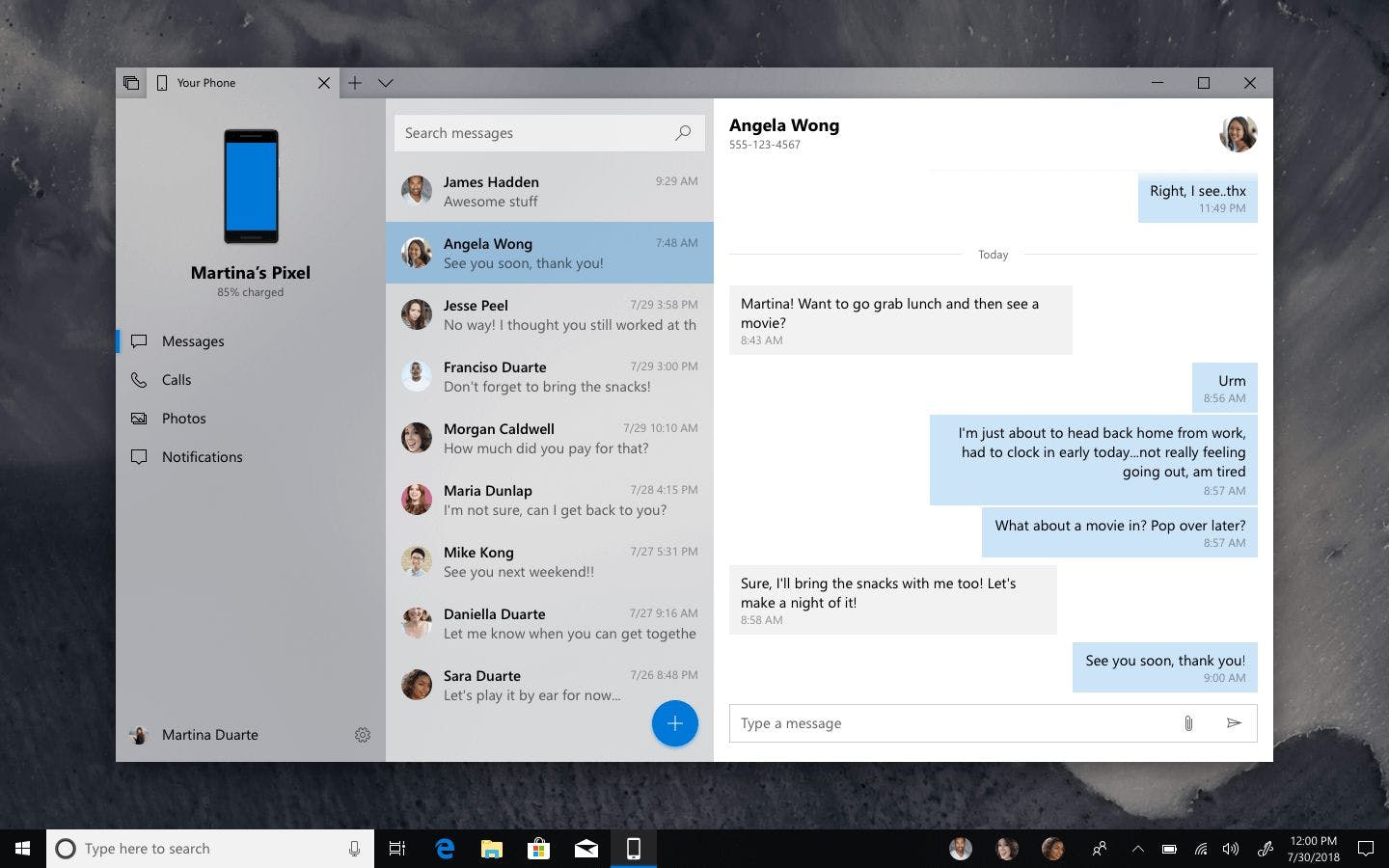
The messaging surface that ships works well. The redesign here is mostly a Fluent refresh with Acrylic material on the message list, a tightened conversation view, the kind of subtle reorganization that catches the app up to where the rest of Windows 10 is moving.
The messages view of Your Phone. No conversation is selected.
The messages view with a conversation thread open.
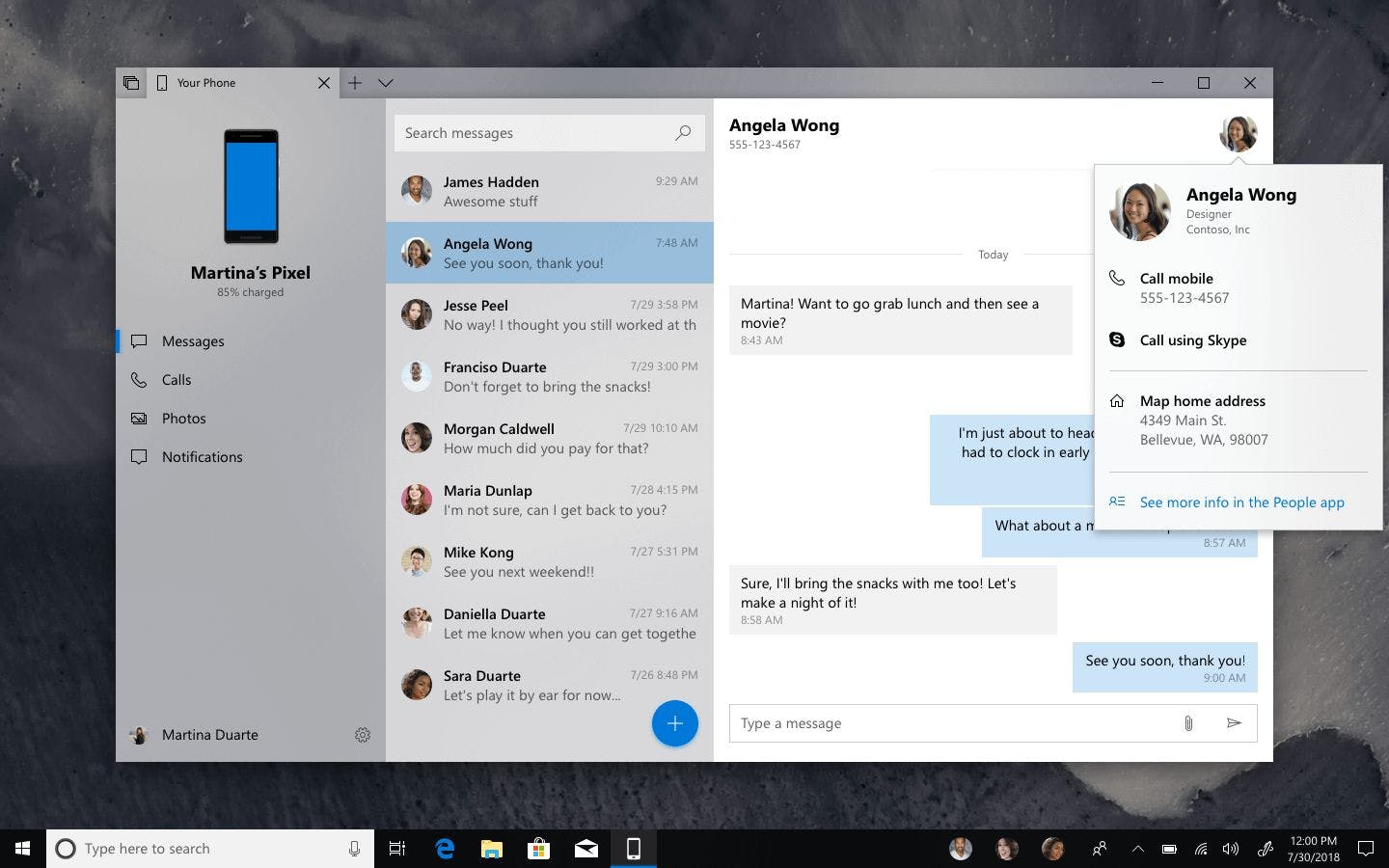
The one new piece is a popover on the contact avatar: clear identity, plus the actions that follow naturally from being mid-conversation including starting a call, opening Skype, sending an email, mapping an address. The contact name/avatar is the obvious thing to interact with when the user wants to do something about the person rather than something in the thread, and the popover puts those actions one tap away.
A popover surfacing contact actions during a conversation.
MyPeople
MyPeople launched with the Fall Creators Update but has struggled to find a use case. It's a beautiful idea: your closest contacts pinned to the taskbar as a persistent surface. But app support is the limiting factor. Only a small set of apps integrate, so most contact pins reduce to launchers for one or two services rather than a genuine cross-app presence.
That's where Your Phone fits.
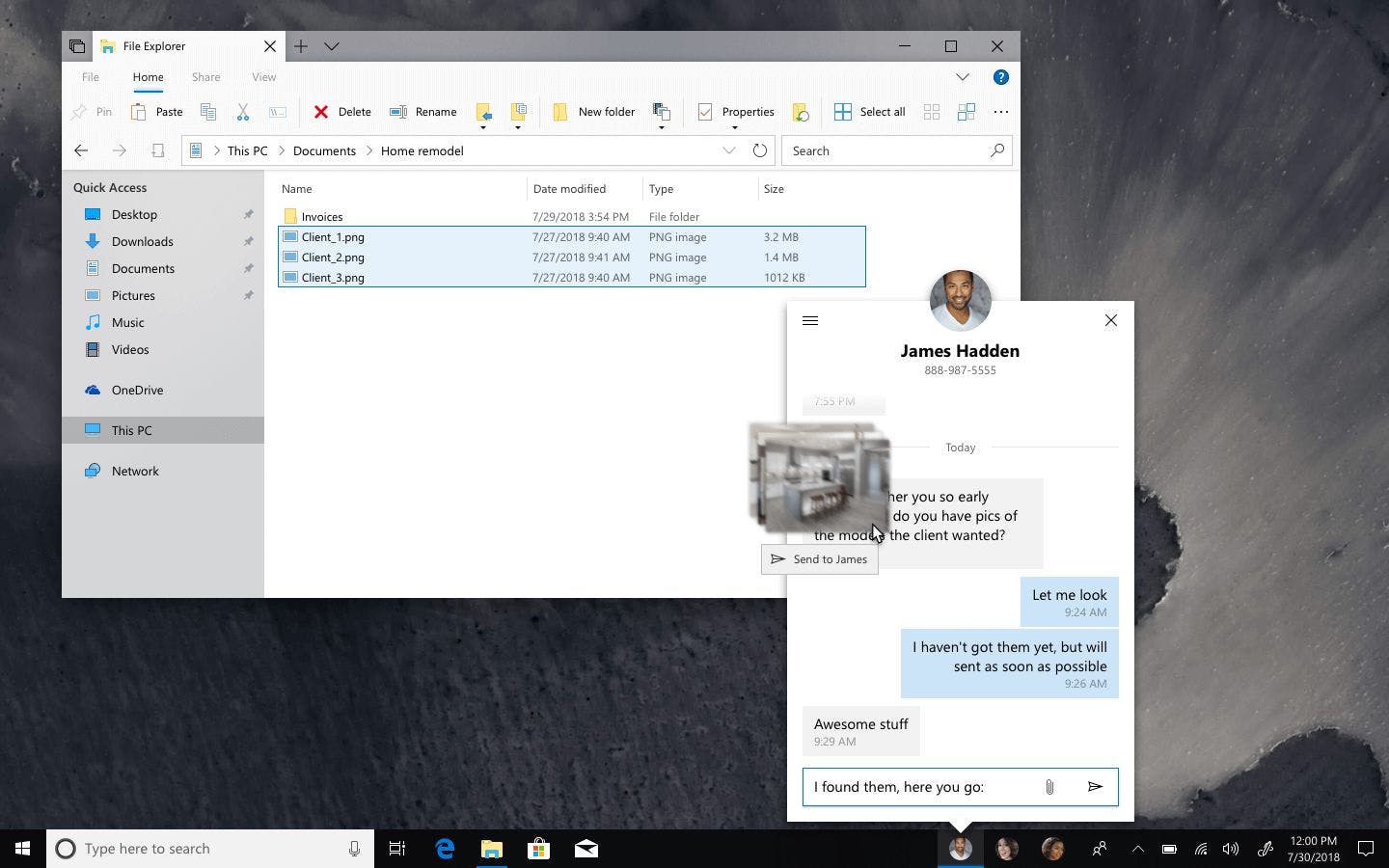
A MyPeople flyout with an ongoing message thread; images are being dragged in from File Explorer.
The MyPeople flyout becomes the thread with that contact, anchored to the taskbar wherever the user is. Drag-and-drop into the thread sends the attachment. And because the desktop knows what it's looking at, dragging images can trigger a OneDrive upload-and-link rather than a raw MMS send (preserving the quality the carrier protocol would otherwise compress away).
This is the use case MyPeople was waiting for. The feature isn't broken; it just needed a reason to exist beyond launching other apps.
Calls
Calling is the next obvious feature for Your Phone, but how it gets there matters. A simple port could mirror the phone's dialer onto the PC. It's useful, but maybe no better than reaching for the phone itself.
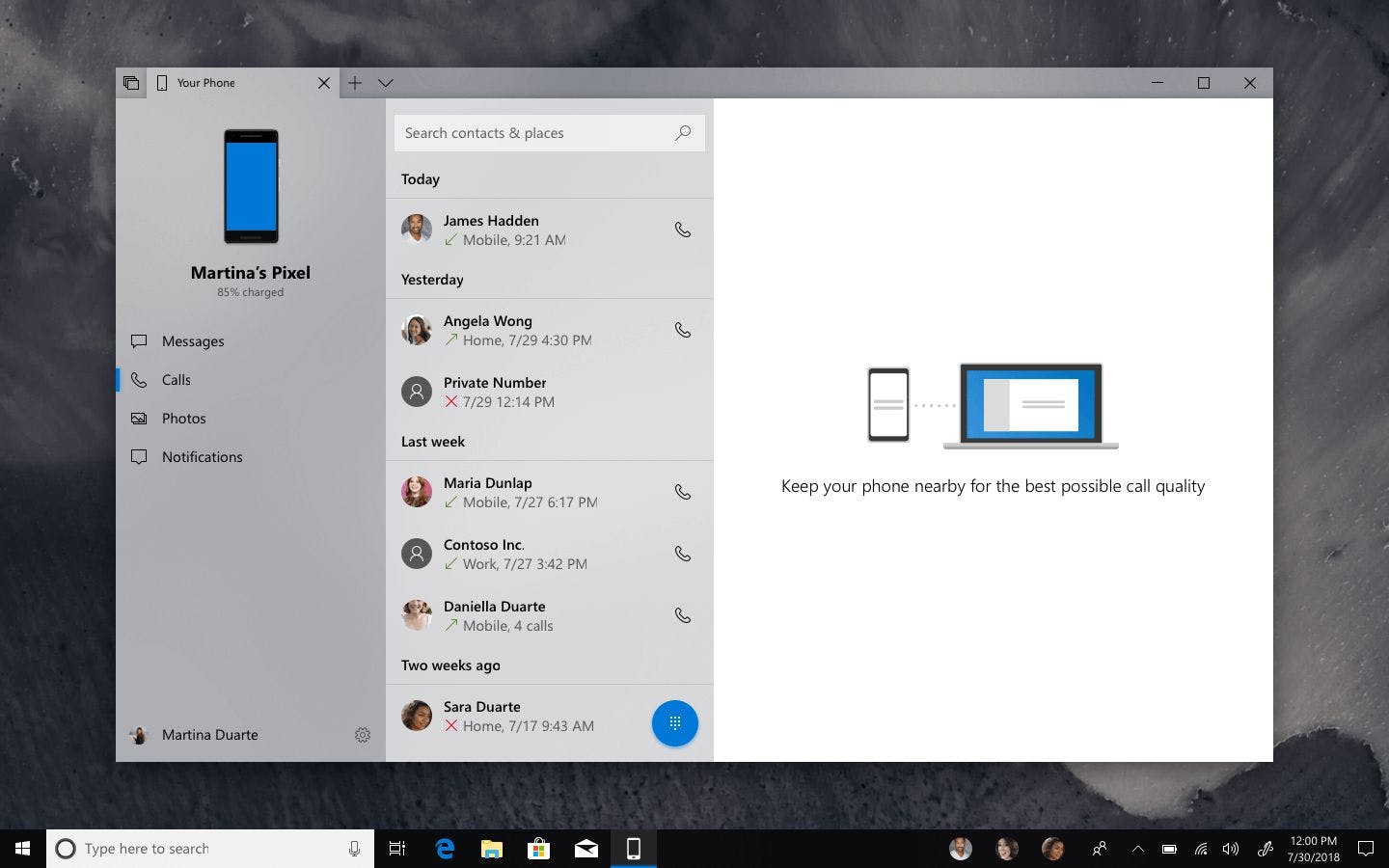
Recent calls from the user’s Android phone.
The recents view is the predictable starting point: outgoing, incoming, missed, with a one-tap callback. Worth doing, but not the interesting part.
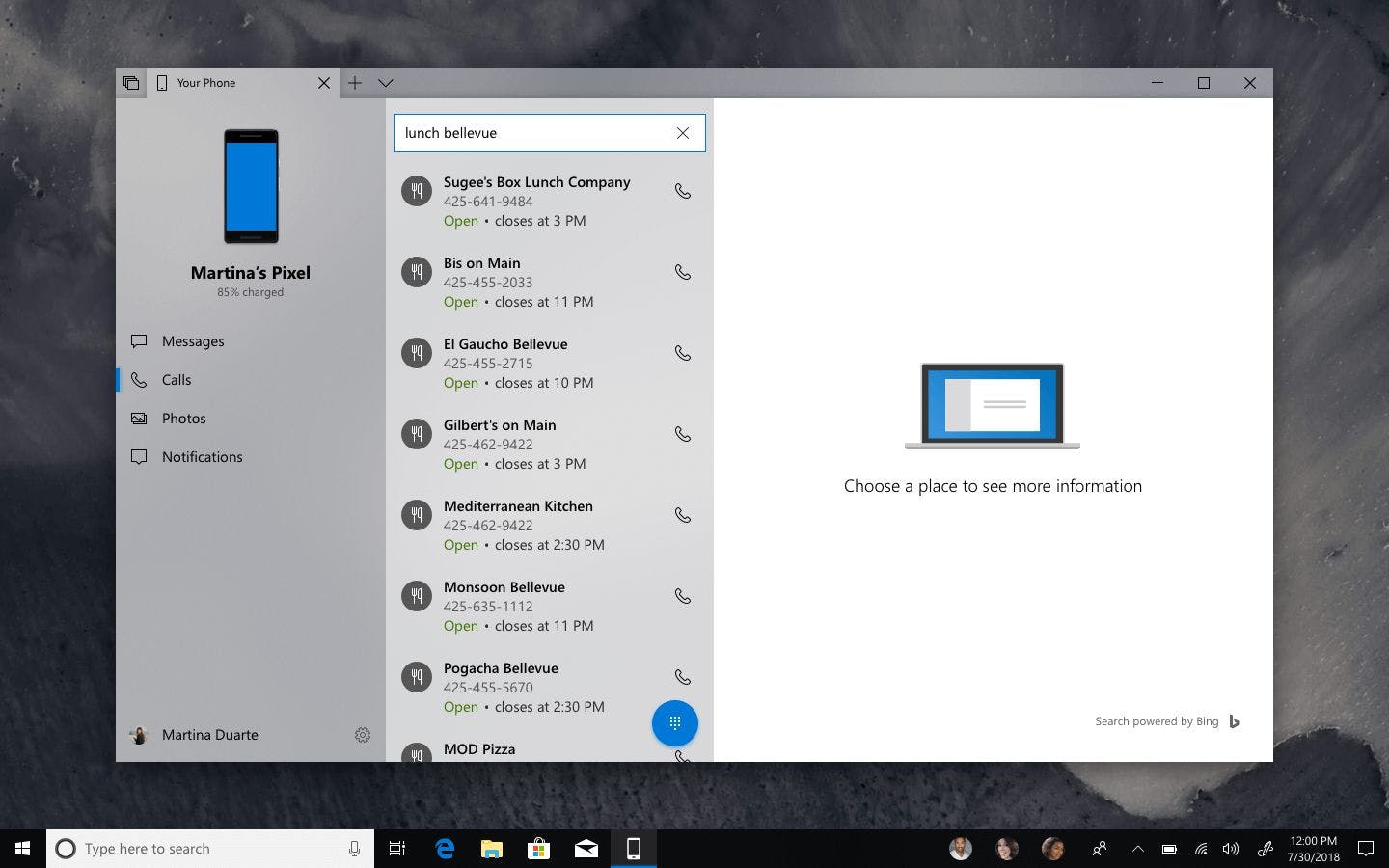
Bing-powered search surfacing local businesses for lunch in Bellevue.
The interesting part is search. The user is already at the PC. Picking up the phone to find a restaurant means switching contexts: putting down what they were doing, unlocking the phone, typing on a smaller keyboard. With search inside Your Phone, the same query that surfaces "lunch in Bellevue" as a web result returns a list of restaurants the user can call without leaving the desk. This is what makes Your Phone more than a mirror: the cross-device experience reaches into the surface the user is already working on.
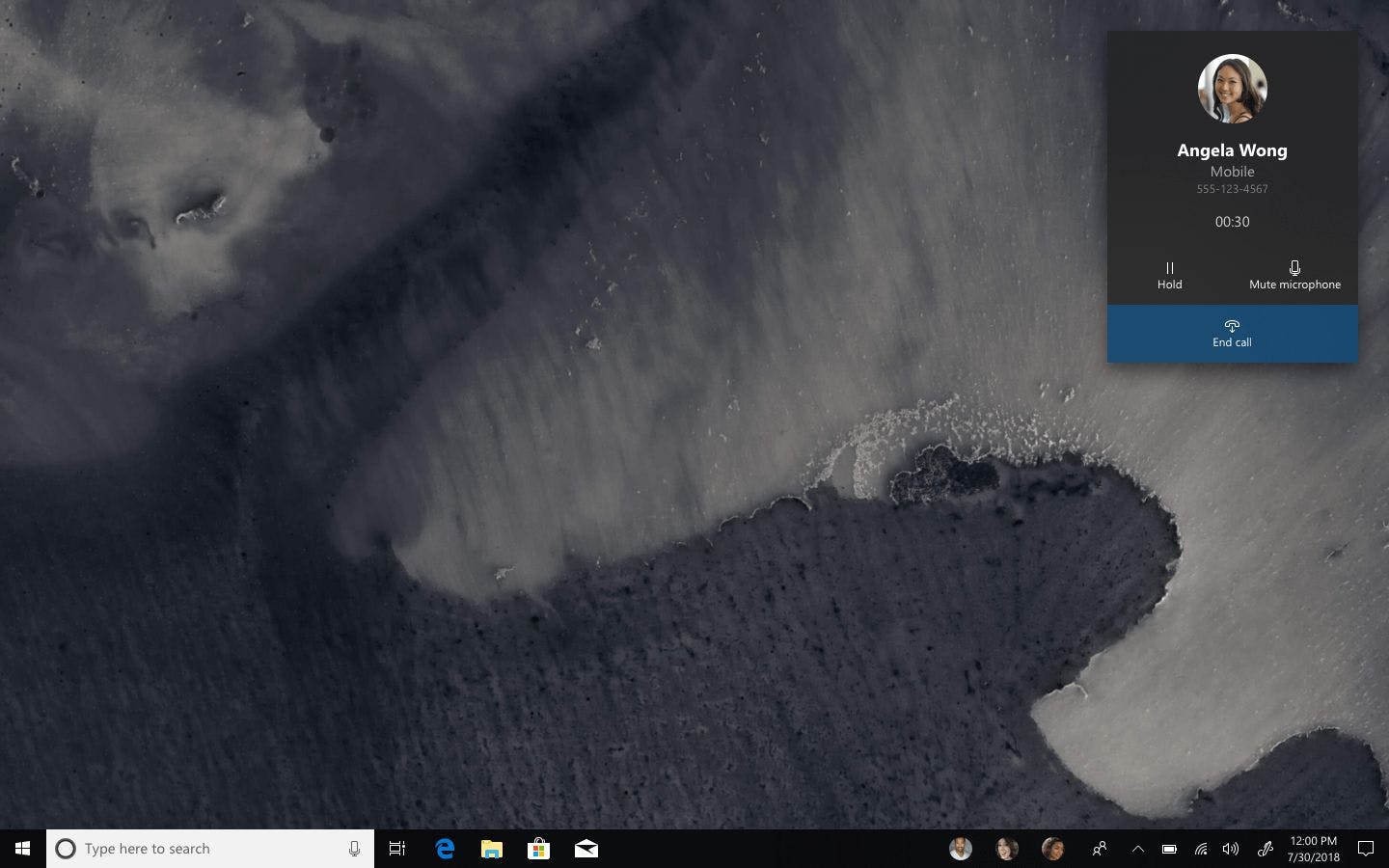
An in-progress call in a CompactOverlay window.
Active calls live in a Compact Overlay window: small, persistent, with the essentials (hold, mute, hang up) one click away. Incoming calls surface as standard Windows notifications.
Inking
Pen input has become a real surface in Windows over the last few releases. The October 2018 update introduces Snip & Sketch and a refreshed Sticky Notes; the platform is leaning into "Creators" as a positioning point. Your Phone should sit inside that pipeline rather than next to it.
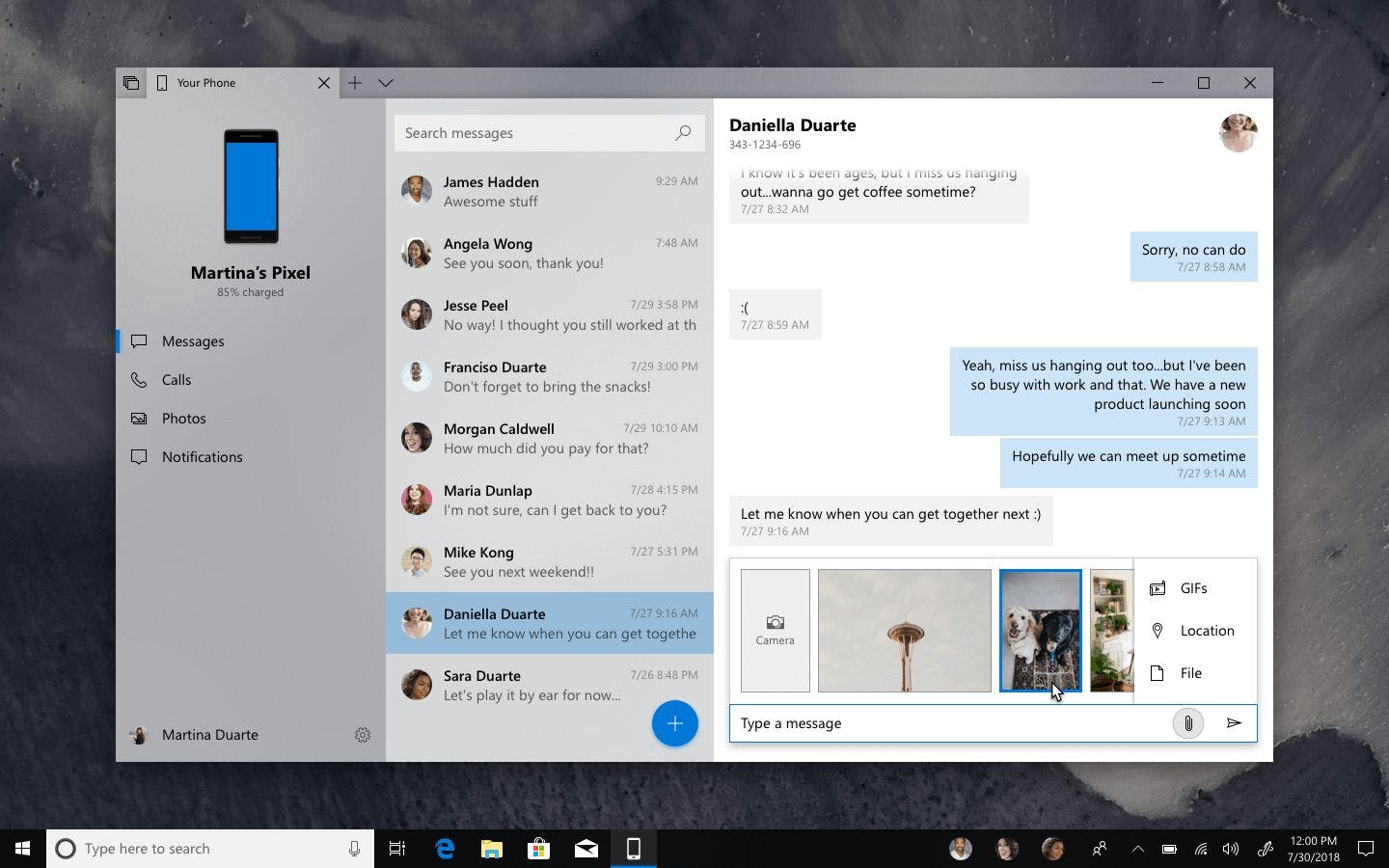
The attachment panel showing recent photos from the user’s phone and PC.
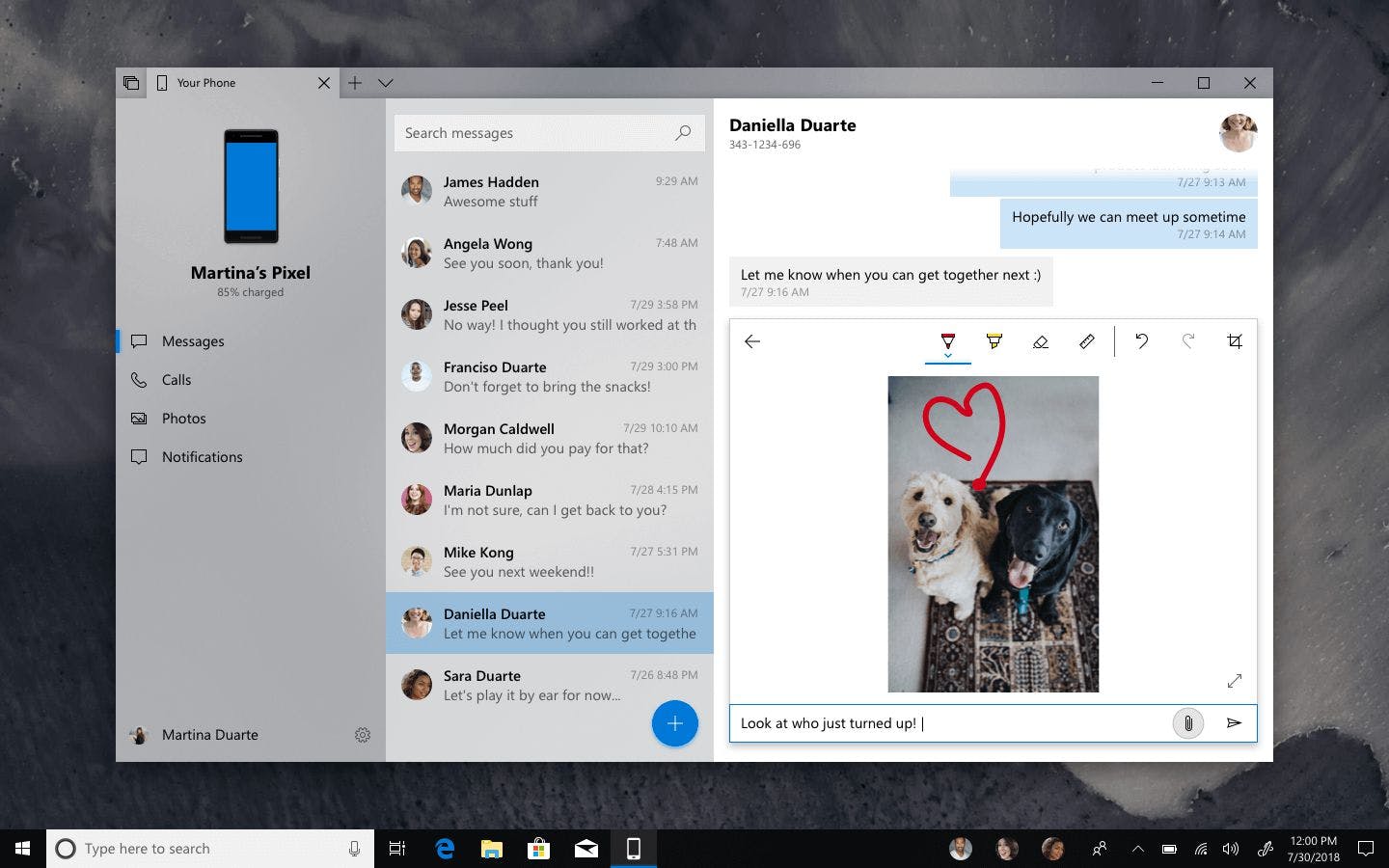
The flow: pick a photo from a unified list of recent images (the phone's camera roll plus the PC's pictures folder are treated as one source), open it in a larger viewer, mark it up with the full Windows Ink toolset, then send.
The attachment markup editor with Windows Ink tools.
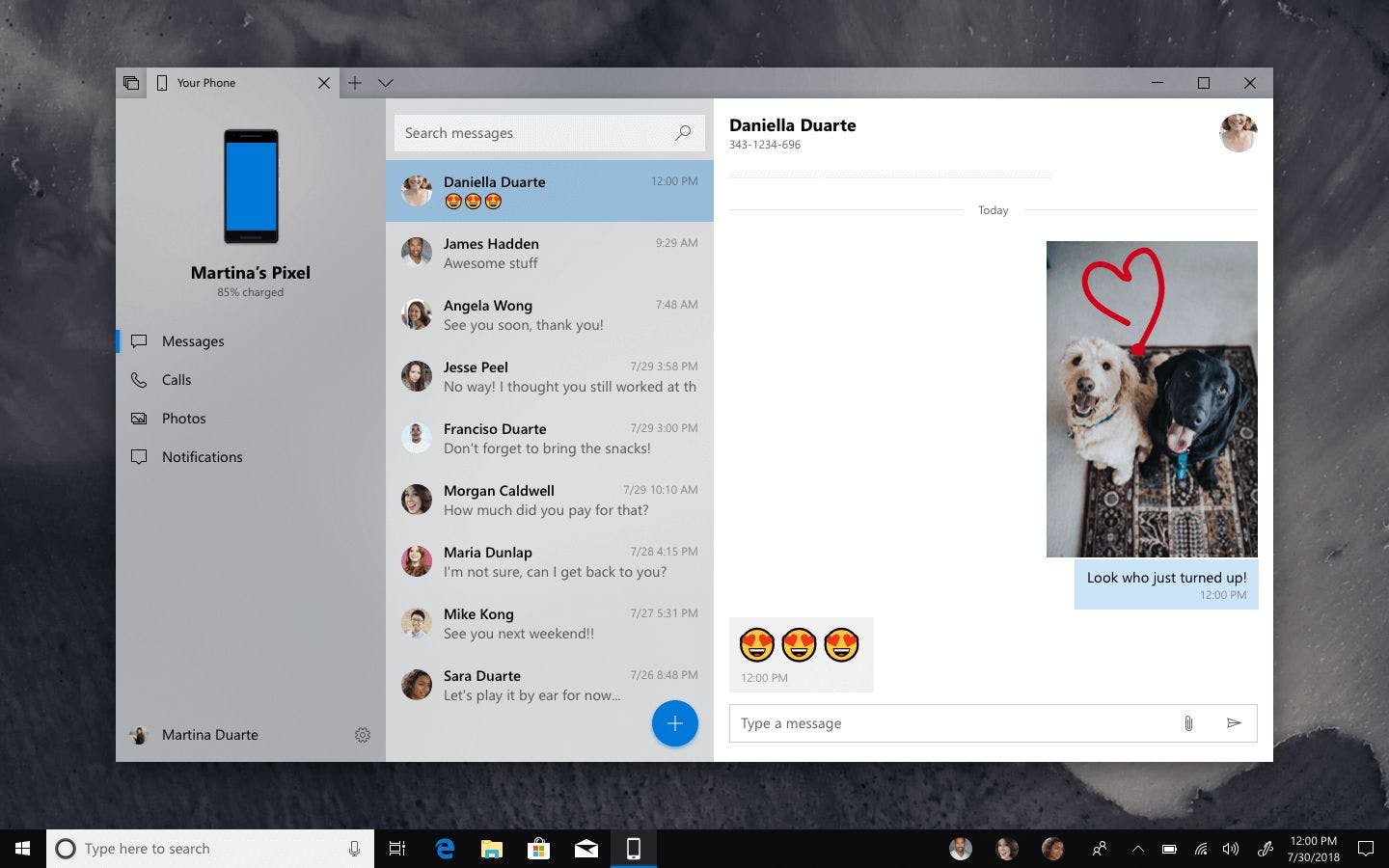
The inked image sent to the recipient.
The point isn't the markup itself. Loads of messaging apps across platforms have some version of that. The point is that Your Phone uses the Windows Ink toolset, with Ink Replay on the receiving end, because the PC is the surface where that toolset already lives.